Wednesday, March 3, 2010

March Madness: Spotlight on A. Vaughn

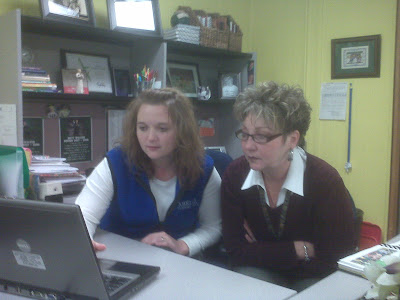
Anita integrates technology with her daily message.

   What causes a "veteran" teacher to embrace the use of technology in the classroom? Of course, today's digital students thrive on instruction supported by technology, but how does a teacher make this shift? This was my question as I visited Anita Vaughn's classroom first grade classroom at Holly Hill Elementary.

   According to Anita, a 25 year veteran, it started with curiosity. She heard about SMART Boards while completing her master's program, but didn't know much about them. Then opportunity knocked. When Nancy Parks, Holly Hill principal, asked Anita to become a member of the district's SMART Board pilot team it was game on!

   Anita began integrating the SMART Board in her math class. She discovered many interactive activites and images that were helpful in viualizing math concepts. She began using dice for addition practice, base ten blocks, clocks, calculators, graphing, measurement, sorting, etc. Even students walking down the hall would wander in to check out the interactive math lesson!

   Once Anita saw how the use of technology increased student motivation and learning, she began to explore other ways to integrate technology and instruction. She now uses technology to project virtual dice with short vowel letter chunks for skills group, projects decodable books from websites, shows author interviews and has students interact with the SMART Board during daily message.

   "At first I was frustrated with some of the technical aspects of the SMART Board, but once I got it up and running, I used it regularly. Now everytime I explore I find something new I can use in the classroom. I find new uses everyday," stated Anita. 

SMART Board... SMART Teacher!

Cheryl


Tuesday, March 2, 2010

March Madness: Making Mistakes

Last Friday I got to hang out with the West Clermont art, music and  tech teachers during a professional learning session. Make no mistake: they are a fun group to spend time with!

We viewed a video clip of creativity enthusiast Sir Ken Robinson. Talk about an interesting guy. He is as informative as he is entertaining. And with this quotation, he reminds us that being wrong is very...well, right!

Sir Ken says, "If you're not prepared to be wrong, you'll never create anything."


His speech totally made me want to dig in, mess up, and create something amazing! Next time you see me, don't hesitate to ask, "What mistakes have you made lately, Tanny?"

Tanny

PS In case you're curious, Correct, Indiana is a little town situated between Madison and Versailles. Only go there if you're ready to be "in Correct".

Monday, March 1, 2010

March Madness: Getting to Done

Okay, it's the first day of March, and I have a crazy idea and a challenge: Can we create a blog post for every school day during the month? That's 23 posts. And that's madness.

But, I think we can do it. We have lots of ideas from Friday's Professional Learning Day, from our February trip to Ohio eTech, and from our recent reading.

We're currently reading Seth Godin's Linchpin. Great read!

Godin writes about "shipping," that is, moving from thinking, talking, planning, resisting, etc etc to DONE. Now I know that it's true in education that we are always "in process," and that we don't always see results right away. BUT, it is true that there is always an end-of-the-day or end-of-the-project, that is, there are lots of things that we CAN get done.

Godin shares Bre Pettis's Cult of Done Manifesto. Here it is is list form (you can see it in graphic form, here):
 1. There are three states of being. Not knowing, action and completion.
 2. Accept that everything is a draft. It helps to get it done.
 3. There is no editing stage.
 4. Pretending you know what you're doing is almost the same as knowing what you are doing, so just accept that you know what you're doing even if you don't and do it.
 5. Banish procrastination. If you wait more than a week to get an idea done, abandon it.
 6. The point of being done is not to finish but to get other things done.
 7. Once you're done you can throw it away.
 8. Laugh at perfection. It's boring and keeps you from being done.
 9. People without dirty hands are wrong. Doing something makes you right.
10. Failure counts as done. So do mistakes.
11. Destruction is a variant of done.
12. If you have an idea and publish it on the internet, that counts as a ghost of done.
13. Done is the engine of more.

So in the spirit of getting it done, let the March Madness begin. 

M.E. 

Saturday, February 27, 2010

Summarizing & Note Taking II


Amelia Elementary teachers respond via wallwisher to our Summarizing & Note Taking module at Friday's professional learning day.

As promised, here are the Summarizing & Note Taking links from the Voice Thread, and more:

Copy/Paste by Peter Pappas 
Pappas on Summarizing & Note Taking
Pappas on Taxonomy of Reflection

Robert Marzano Free Resources
Robert Marzano Meta-Analysis Database

Cornell note taking template

On Doodling here on TLC: Teaching. Learning. Community.

Janet Allen's Tools for Teaching Content Literacy (flip book)

We look forward to hearing your ideas about using these strategies in your classroom.

M.E.

Monday, February 22, 2010

Summarizing & Note Taking I

Making Thinking Visible

We can maximize our chances of making difficult content sticky if we broaden our definition of note taking.

Summarizing & Note Taking is one of Robert Marzano's high yield instructional strategies, with benefits for students of all ages and for all kinds of content (I like to say "from Kindergarten to Calculus").

Learn about this and more as you listen to the Voice Thread we created for West Clermont's February 26 Professional Learning Day to align with the Ohio Improvement Process and our school improvement plans.

Full screen version, click here.


With thanks to Superintendent Gary Brooks for the introduction and to education consultant Peter Pappas for adding comments to the Voice Thread. Pappas will be working with teachers and administrators in September 2010.

For links, click here.

M.E.

Wednesday, February 17, 2010

It Felt Like Learning to Me

Amelia Elementary Principal Stephanie Walker shares her blog project.

     Recently, I was working on a project and became "stuck." I was trying to create a new blog site and  couldn't seem to move forward. My work seemed only mediocre and I quickly became frustrated.

     Then a colleague shared her blog project with me. We collaborated... we talked about what was working and what was not. We problem-solved and created new ways of thinking about our projects...we shared our brains!

     Before I knew it I was ready to move forward again. I was motivated with new ideas and my frustration had disappeared!

     Collaboration is not only important for educators, but for students too. All students can benefit from collaboration with a peer on class work, assignments, etc.

    Take it from me... collaborating with a peer or colleague is not "copying" or "cheating." In fact, it felt a whole lot like learning to me!

Don't forget to share your brain...
Cheryl

Wednesday, February 10, 2010

Shift Happens


     Shift happens... in fact, it already has. Try to find a pay phone, a typewriter, a transitor radio. They have virtually disappeared from our cultural landscape. Ready or not... the digital future is here.

     This means students coming to our schools today are digital natives. They have never known life without cell phones, video games, instant messaging, etc. In fact, this constant bombardment of digital information is what Ian Jukes refers to as "InfoWhelm."

     According to Jukes, constant exposure to InfoWhelm has resulted in a different kind of learner. Quite simply, kids are wired differently. While we tend to process information in a linear, sequential manner, today's students are "hyper-linked." They are parallel processors and multi-taskers... they can listen to their iPod, text message a friend and watch a video, all while doing homework. They prefer to process pictures, sounds, video and color before text. They prefer instant gratification and immediate rewards.

     As a result, schools are not always friendly places for these digital natives. Instead of being allowed to access information quickly from multiple sources, students are often subjected to a slow and controlled release of information. They are expected to gain information from pages and pages of text without picture, sound or video. Or they are expected to work independently, without the benefits of networking .

     Yes, basic skills are still imporant. They form the building blocks for higher learning. But they are no longer enough. Unfortunately, many schools are not ready to address the unique needs of this digitial generation. In a way these schools are like the wall of obsolete telephones... watching in silence while shift happens.

     If you would like to learn why basic skills like literacy are not enough, click here to read Ian Juke's 21st Century Fluencies for the Digital Age.

Cheryl (a digital immigrant)